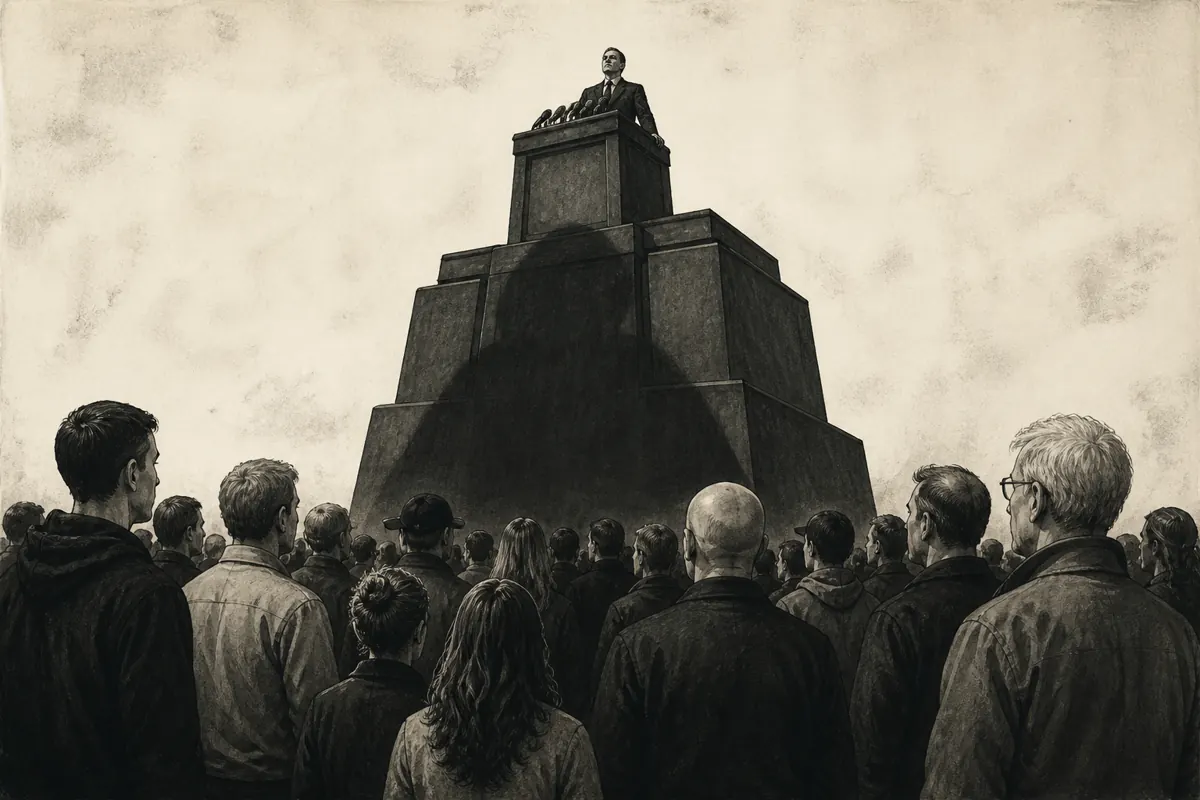
Every order has demanded a final voice
Political history is filled with different rulers, but the architecture beneath them has remained remarkably familiar. The emperor, the monarch, the party, the parliament, and the elected president all inherit the same throne: the right to produce one final order for a society that never possessed one final will. The costume changes. The demand for singular obedience survives.
This demand was once defended by divine inheritance. It was later defended by civilization, national destiny, revolution, expertise, security, and majority rule. Each language promised to end arbitrary power. Each eventually learned to describe its own concentration of power as necessary, temporary, or simply too rational to oppose.
The people are invoked after being simplified
Every government claims to act for the people, but the people must first be reduced to something governable. Their conflicting histories become a national story. Their different communities become private interests. Their dissent becomes noise around an official center. Only after this simplification can the state announce that one policy, one identity, and one political direction express the common will.
The people who do not fit are not always imprisoned. Modern power has subtler methods. They are consulted without being obeyed, represented without governing, counted without being heard, and permitted to speak after the decisive institutions have already chosen the boundaries of the possible.
We refuse political disappearance
Pluralarchism begins with a refusal. No peaceful community should have to disappear politically merely because it cannot become a national majority. No citizen should be forced to choose between permanent defeat inside the state and complete separation from it. No government should call domination unity simply because the domination passed through a ballot box.
We seek neither the destruction of common life nor the multiplication of isolated states. We seek a common order that no longer requires one center to absorb every legitimate difference. We seek a nation capable of containing many political futures at once.
The crisis is already visible
The old architecture is not failing only at its edges. Across societies, people distrust institutions that speak in their name, national elections become battles for total cultural control, and defeated groups increasingly doubt that the next vote will alter their condition. Governments respond by centralizing information, policing dissent, and demanding greater unity. The medicine reproduces the illness.
Pluralarchism does not invent a crisis in order to sell a cure. It names a crisis already expressed through separatism, authoritarian reaction, political withdrawal, and rage against distant institutions. The choice is not between a stable present and a dangerous experiment. It is between conscious transformation and the uncontrolled fragmentation produced when singular rule can no longer sustain belief.
The democratic record forbids complacency
The crisis is measurable. The V-Dem Democracy Report 2026 estimates that by the end of 2025 the world contained 92 autocracies and 87 democracies. It places 74 percent of humanity, roughly six billion people, under autocratic rule and only 7 percent in liberal democracies. For the average person, its measures put democracy back at the level of 1978. Elections did not prevent this reversal. In many cases, elected rulers used the authority of victory to weaken the institutions capable of limiting them.
International IDEA reaches the same emergency from another direction. Its 2025 report finds that global performance in Representation fell to its lowest point since 2001, with seven times more countries declining than advancing in 2024. It classifies 71 countries, 41 percent of those assessed, as low-performing on Rule of Law. These figures do not prove every claim of pluralarchism. They destroy the comforting claim that the existing democratic form is basically healthy and needs only better candidates.
We are not confronting an accidental collection of bad leaders. We are confronting institutions that repeatedly convert temporary electoral advantage into control over law, administration, information, and national identity. When democratic decline occurs through legal procedures, defending procedure alone is not enough. Democracy must be reorganized so that no victory grants one coalition the practical power to close the future of all others.